The tile roofs have been known to last longer; however, the tiles themselves are only components of the system. Below them is the underlayment, which often goes unnoticed but has a significant impact on the long-term performance of a tile roof. In fact, the underlayment usually determines a tile roof’s ability to withstand moisture, heat, and wear.
This article defines roof underlayment for tile roofs, the primary types in use, and how to consider durability and performance without making this a purchasing or sales manual.
What Roof Underlayment is and Why Tile Roofs Depend on It?
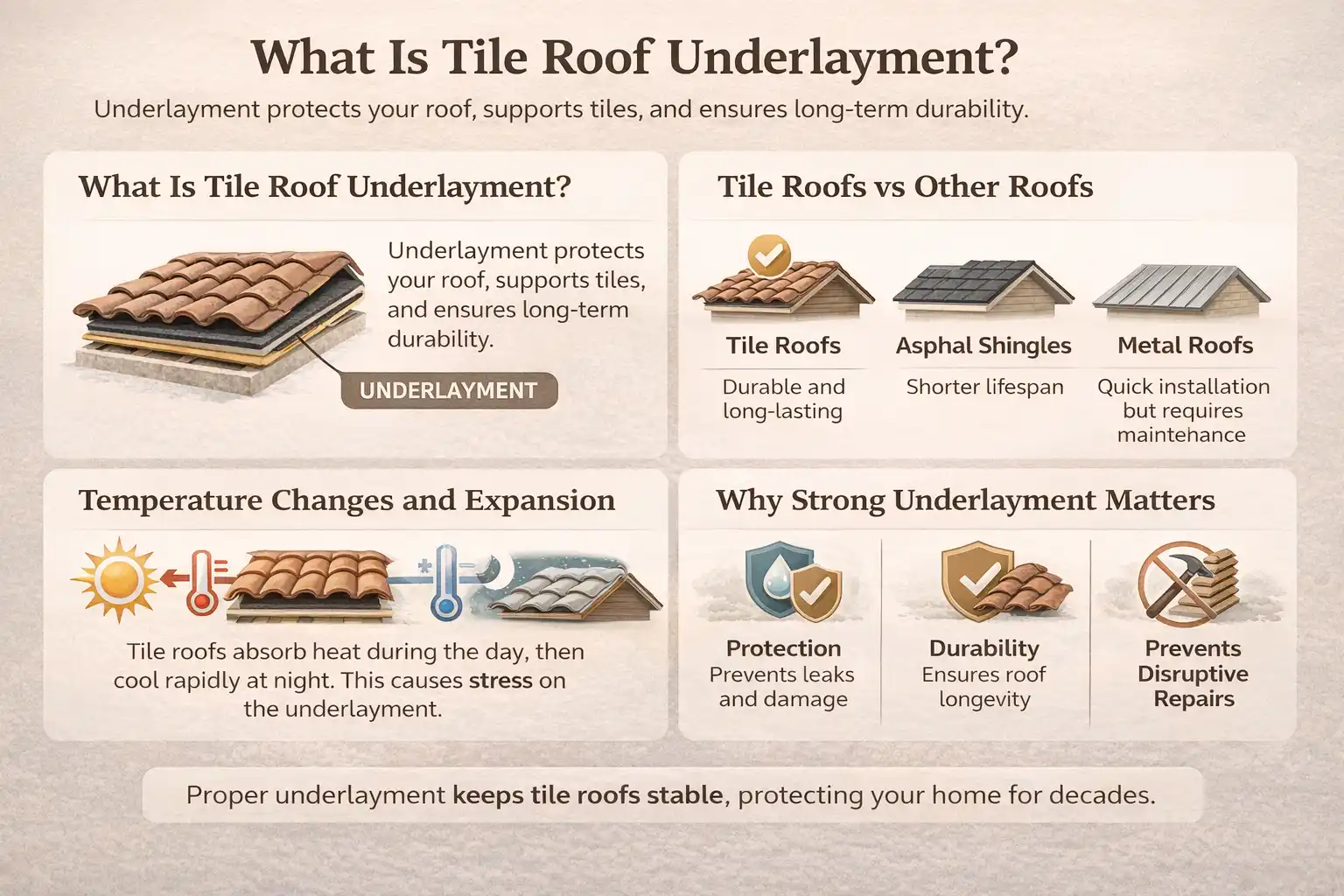
Roof underlayment is a protective layer installed directly on the roof deck, beneath the tiles. Its main task is to serve as the secondary waterproofing.
Single tile roofs are not water-resistant. Melting snow, condensation, and wind-blown rain may move between tiles. So, underlayment is important. It is an impermeable coating used to shed water and cover the roof deck when tiles allow water entry. Tile roofs are dependent on underlayment to perform most of their waterproofing. This further underscores the significance of selecting underlayment.
Why Underlayment Matters More for Tile Roofs Than Other Systems
Tile roofs are durable, as they can last for decades and easily outlast other roof materials. Tiles are bulky and are normally reused when repairing the roof. Removing them to replace the failed underlayment is work-intensive and disruptive. As a result, the underlayment’s strength is more crucial in this case than in short-term roofing systems.
There are also major temperature variations recorded with tile roofs. During the day, tiles absorb heat, and at night they cool very quickly. Such artificial expansion and contraction strains the layers underneath, so in this case, underlayment is very important.
How Underlayment Enhances Durability and Performance
Underlayment enhances roof performance in several ways.
- To begin with, it controls water intrusion. The underlayment will prevent water from reaching the deck when it slips through the tiles and will direct it to drainage points.
- Second, it helps shield the roof deck from moisture over the long term. Rot or mould will develop in a small area if moisture is allowed to persist without a reliable barrier.
- Third, underlayment offers support to thermal movement. Better materials are flexible over time and experience less cracking during temperature changes.
Common Types of Underlayment Used Under Tile Roofs
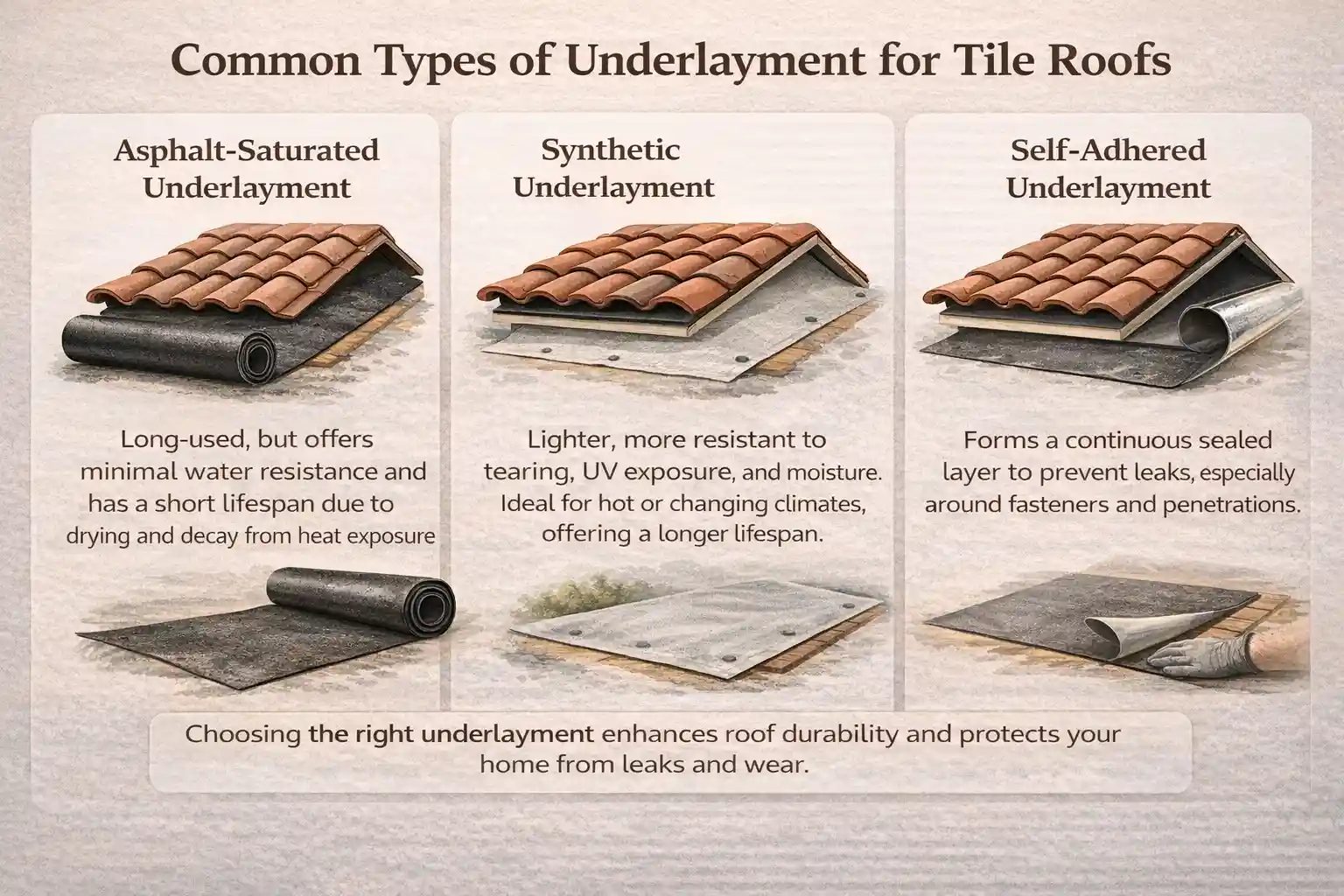
Asphalt-Saturated
This underlay has been in use for a long time. It has minimal resistance against water and limited protection.
However, it dries out, gets wrinkles, and decays more rapidly when subjected to prolonged heat. It has a short life.
Synthetic Underlayment
Artificial underlayments are lighter, made of nylon, and more resistant to tearing and temperature changes. They are more resistant to UV exposure during installation and less susceptible to moisture absorption.
When it comes to tile roofs, synthetics are commonly selected because they last longer than felt, particularly in hot or changing climates.
Self-Adhered Underlayment
Self-adhered underlayments are adhered to the roof deck to form a continuous, sealed layer.
They perform well in areas with leaks around fasteners, penetrations, and complex roof lines. This sealing can be useful, as tile roofs often have several penetrations. When water accumulates on the bottom, issues arise over time.
What “Best” Really Means for Tile Roof Underlayment
A uniform underlayment cannot exist behind all tile roofs. The decision to make is the right one, determined by weather, roof pitch, air conditioning, and the roof’s projected lifespan.
Long-term flexibility and heat resistance are the most important in hot regions. Waterproofing and the ability to seal itself are more significant in places where moisture from heavy rain or wind is prevalent. Strong underlayment is the one that you can use in almost every condition.
When Underlayment Selection Goes Wrong
Failure of the underlayment is not normally caused by fault.
There are timing problems in using short-life materials under long-life tiles. The tiles stand firm, and the underlay sander off underneath.
Poor installation is also a problem. Patterns of fasteners, intersections, and seal marks are equally important as material selection.
Another common mistake is neglecting ventilation. Even high-quality underlayment may fail too quickly if heat and moisture are trapped in the roof construction.
How Long Does Tile Roof Underlayment Typically Last?
Underlayment lifespan is a wide range. Felt tiles have a short lifespan, whereas synthetic and self-adhered systems are designed to have a very long lifespan.
Performance is affected by environmental exposure, roof design, and installation quality. Problems can be detected through periodic inspections, which help prevent damage to decks.
This can be explained by the fact that understanding underlayment as a performance layer is not merely a required component; it is, in a way. Supporting tile roofs requires the best underlayment that aligns with the roof’s design, environment, and expected service life to maintain its durability, rather than compromising it.
Frequently Asked Questions
1. What is roof underlayment for tile roofs?
Roof underlayment is a protective layer placed beneath tiles that helps prevent water from reaching the roof deck.
2. Why is underlayment important for tile roofs?
Tile roofs depend on underlayment for waterproofing, especially due to temperature fluctuations and moisture exposure. It enhances durability and performance.
3. What types of underlayment are used under tile roofs?
Common types include:
- Asphalt-Saturated Felt – Traditional but limited in heat and water resistance.
- Synthetic Underlayment – More durable, resistant to tearing and UV.
- Self-Adhered Underlayment – Seals roof lines and penetrations effectively.
4. How long does underlayment last?
Underlayment lifespan varies: felt has a shorter life, while synthetic and self-adhered systems are longer-lasting with proper maintenance.
5. How do I choose the best underlayment for my tile roof?
The best underlayment depends on climate, roof pitch, and expected lifespan. Hot regions need heat-resistant materials, while moist areas need waterproofing.